How Harbinger Became the Beginning of the Sam Rourke Series
Steven Harrison explains how editorial feedback transformed Harbinger from a standalone psychological thriller into the beginning of the Sam Rourke series.
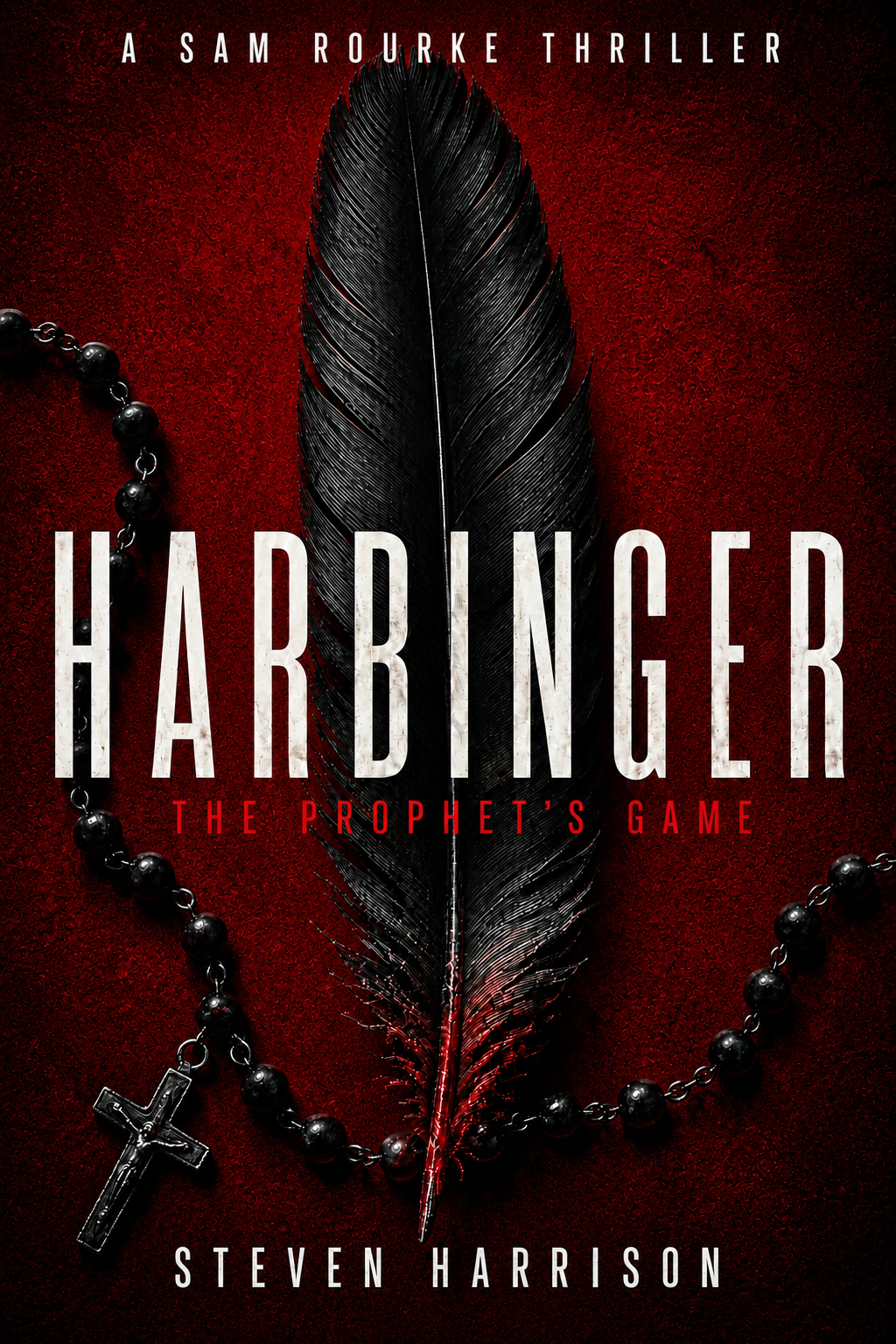
When I first started writing Harbinger: The Prophet’s Game, it was never intended to become the first book in a series.
At the time, it was designed as a standalone psychological thriller: dark, self-contained, and focused entirely on the murders, the conspiracy behind them, and the atmosphere surrounding the investigation.
And, interestingly, Sam Rourke did not even exist.
At least, not in the form readers will come to know him.
The detective before Sam Rourke
The original manuscript featured a different lead detective altogether. He was capable enough, intelligent enough, and functional within the story, but something was missing. The emotional weight was not fully there. The character served the plot, but he did not truly command it.
It was not until editorial feedback from a literary agency that the story began to change direction.
“The investigation is compelling, but the central figure needs greater presence: someone more focused, more experienced, and emotionally grounded enough to carry a larger narrative.”
That feedback forced me to rethink everything.
Somewhere during that rewrite, the foundations of Sam Rourke appeared.
Not fully formed. Not immediately. But slowly, chapter by chapter, the man who would become Rourke started taking shape on the page.
A character with a history
He brought something entirely different to the story:
- Discipline.
- Control.
- Emotional restraint.
- A sense of history.
He felt like a man who had survived things long before the opening chapter ever began.
Suddenly, the story had gravity.
I remember reaching a point midway through the rewrite and thinking:
“This character feels like he has walked out of a much bigger world.”
That was the moment the novel began transforming into something larger than a standalone thriller.
When Chicago became part of the story
As Rourke developed, so did the world around him.
The corruption deepened. The psychological themes became darker. The conspiracies became more layered. The idea of Chicago itself started feeling alive: dangerous, secretive, and filled with stories still waiting to be uncovered.
What surprised me most was how naturally it unfolded.
I never sat down and decided, “I am going to write a multi-book detective series.”
Instead, the series revealed itself through the character.
A story that could not end with one case
The deeper I wrote into Rourke’s psychology, the clearer it became that his story could not end with a single case.
There were too many scars. Too many unanswered questions. Too much unfinished history beneath the surface.
I wrote a note to myself during the later chapters that simply said:
“This city still has secrets Rourke has not uncovered yet.”
That note ultimately became the foundation of the series itself.
By the time I reached the final chapters of Harbinger, I realised I was not closing a story.
I was opening a world.
The beginning of the Sam Rourke series
The Sam Rourke series was never planned in the traditional sense. It emerged organically through rewrites, editorial development, and the gradual discovery of a character who became impossible to ignore.
Looking back now, I think the strongest protagonists are not always invented intentionally.
Sometimes they arrive unexpectedly and refuse to leave.