The Bit Nobody Puts on the Cover
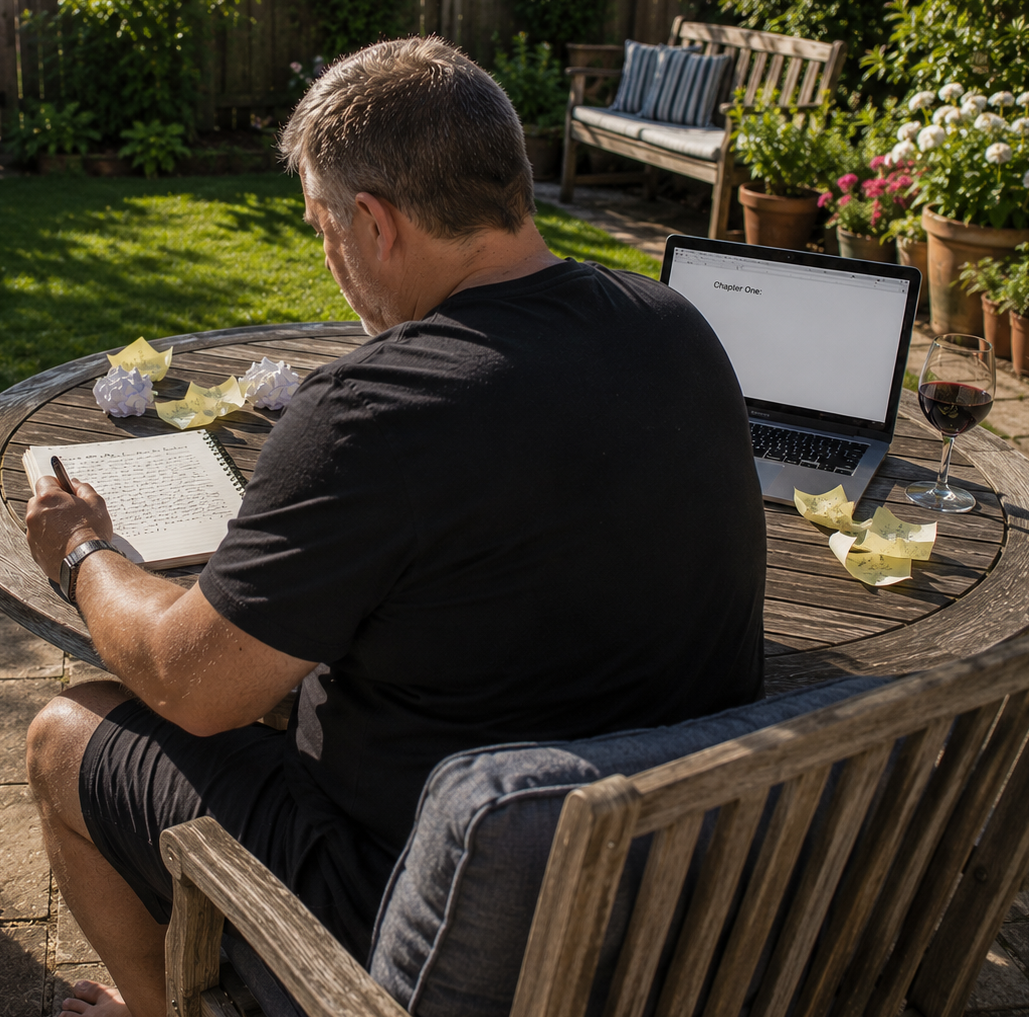
People think publishing a book goes like this:
Write book. Publish book. Become mysteriously successful overnight.
I’d like to introduce you to reality…
Stage one: the idea. You get it in the shower, or while driving, or at 3am when your brain decides sleep is for people with fewer commitments. It arrives fully formed and perfect. You think: this is the one. Masterpiece!
You will never feel this good about the book again… Ever!
Stage two: the blank page. You open a new document and immediately forget how sentences work. You type a line. You delete it. You type it again, slightly differently. You Google “how to start a novel” as though the answer might have changed since the last time you looked.
Stage three: Chapter One. You write it and it sings. You are, briefly, a genius. You consider what you’ll wear to the awards ceremony.
Stage four: Chapter Seven. The book is nonsense. You are a fraud. Every word is garbage and you should have gone fishing instead.
Stage five: you keep going anyway.
This is the entire job, incidentally. Everything else is technique.
Finally, the draft is complete. A pat on the back. A glass of wine and then… and then.. what the hell am I supposed to do now?
Then the fun really starts. Then you discover that writing the book was the easy part.
Editing
You cut a scene you loved because it doesn’t earn its place. You rewrite a scene you hated and discover it’s now one of the best things in the book. You realise the ending you planned in week one has quietly packed a bag and left without leaving a note. So you write a new ending, and it’s better, and you resent it slightly for that. And then decide that the first scene you deleted days ago, now fits perfectly, but you can’t remember the exact detail. huh!
You give a character a name. Then you change it. Then, four hundred pages later, you discover you only changed it in some chapters, and now two people in your novel are the same man wearing different surnames. You spend an evening with the find-and-replace function and the growing suspicion that you have invented a new kind of tedium.
You send the manuscript to beta readers, which is a bit like handing someone your diary and asking them to grade it. One says they couldn’t put it down. Another gives you four out of ten and eleven pages of notes so forensic you have to go for a walk.
Both of them are helping.
Only one of them feels like it at the time.
Because now there’s the cover. And the blurb. And the formatting, the trim size, the paper stock, the spine width calculation that changes if you add four pages. There’s the ISBN. There’s the metadata, the keywords, the categories, the pre-order date, the release date, the paperback, the hardback, the eBook, the website, the newsletter, the social media, and the dawning horror that you are now running a small publishing business staffed entirely by one person who just wanted to tell a story about a detective in Chicago. And all for less than 1p an hour.
At some point you catch your reflection at midnight, surrounded by spreadsheets, notes, proofs and cold coffee (who am I kidding, I am three glasses of wine in at this point.), and think:
I did this to myself. Voluntarily. For fun.
And then you carry on. Because the alternative is a finished manuscript sitting in a folder, and somehow that feels worse.
Here’s the thing nobody tells you, though.
All of it — the cut scenes, the rewrites, the notes that stung, the nights spent chasing one wrong name through four hundred pages — all of it is the book getting better.
Not just finished. Better.
Every one of those unglamorous, un-Instagrammable hours is for a reader, some months from now, not stumbling over a sentence. Not spotting the join. Not being pulled out of the story because something doesn’t quite work.
Just falling in. They’ll never know most of it happened. That’s rather the point.
So when you see a cover and a release date, know that underneath it there’s a long stretch of second-guessing, redrafting, learning, panicking, fixing, waiting, and stubbornly refusing to let the thing go before it is ready.
That is the strange joy of writing a novel.
It tests your patience, your confidence, your judgement, your eyesight, your tolerance for admin, and occasionally your relationship with Microsoft Word.
But then, somehow, after all of that, a story that once existed only in your head starts becoming real.
A book page appears. A cover takes shape. Beta readers begin sending thoughts. The website grows around it. A pre-order date approaches.
And suddenly the thing you nearly abandoned in Chapter Seven has a release date, a series name, and people asking when they can read it.
The truly unhinged part? You finish. You hold it. You think: yes, that was worth it.
And then you sit down and start the next one.
Harbinger: The Prophet’s Game is the first novel in the Sam Rourke Thriller Series, coming 1 September 2026.
Thanks for reading.