When the Book Stops Being Yours
Release day doldrums
There is a peculiar moment after publishing a novel when you expect something to happen. Something… EPIC!
OK, not epic, not even a fanfare of trumpets. That might be excessive. But perhaps a small light somewhere could flash.
At midnight on 1 September, Harbinger: The Prophet’s Game was officially released. A status changed on a screen. The house remained quiet. Nothing exploded.
After nearly two years of writing, rewriting, editing, proofing, formatting and repeatedly discovering that changing four pages also changes the width of a book cover, publication arrived with remarkably little ceremony.
It was possibly the greatest anticlimax of my life.
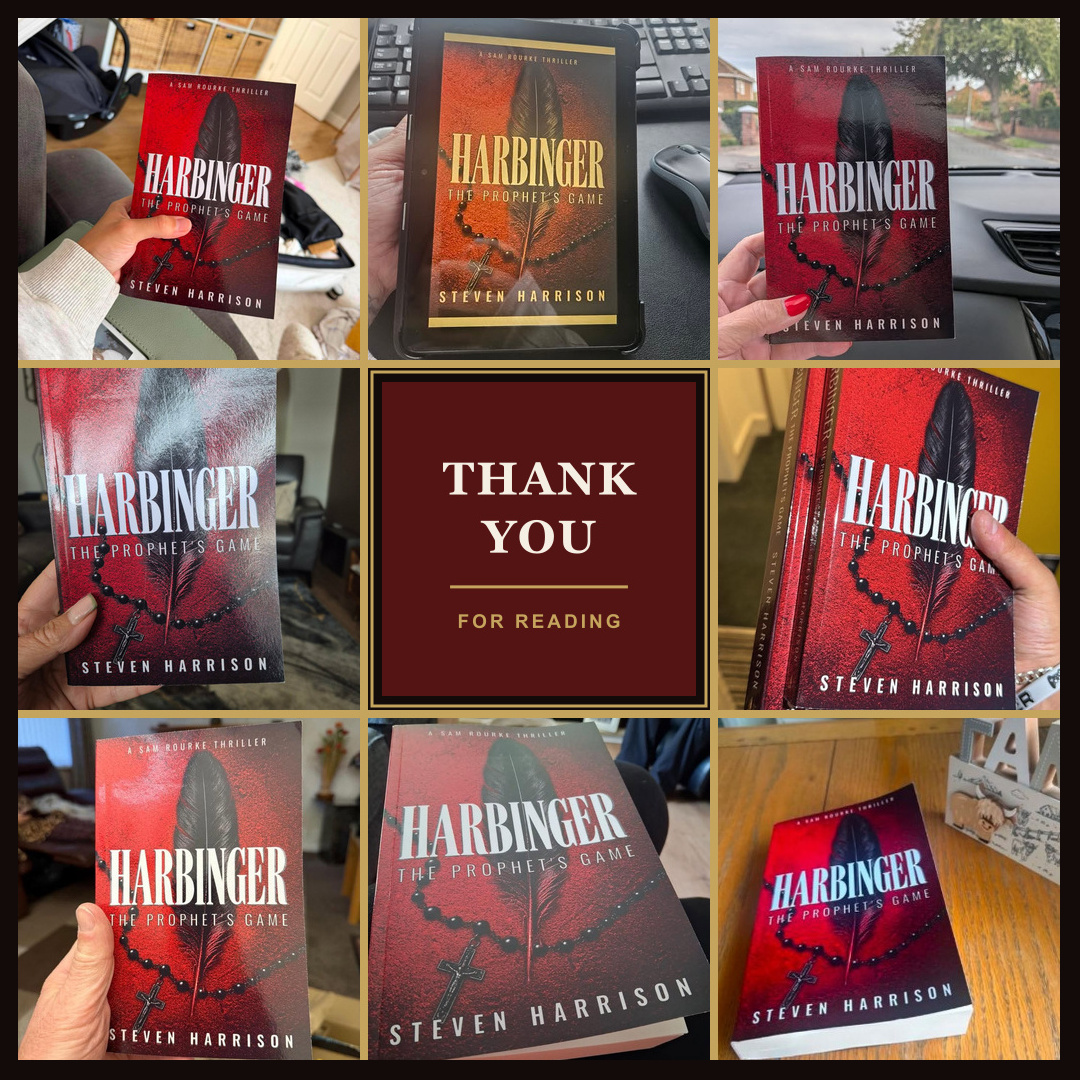
Then the photographs started arriving.
Copies held in living rooms, kitchens and cars. A Kindle displaying the cover. Paperbacks sitting on tables or already showing the first signs of being read.
That was when it became real.
Until publication, the book had always belonged to me. Even when beta readers were working through it, I could still revise a sentence, repair a scene or question every decision I had made since Chapter One.
Now people were reading the finished novel. They were meeting Sam Rourke, Celeste Ramirez and Miles Carter without me standing beside them to explain anything.
The book had stopped being entirely mine.
From Manuscript to Object
The final weeks before publication were dominated by details I had once assumed would take about ten minutes.
Margins. Paragraphs. Scene breaks. Copyright pages. Spine widths. Print templates apparently designed by people who consider clarity a personal weakness.
There were paperback proofs, hardback covers and a dust jacket that needed to work as one continuous piece of artwork. There were last-minute corrections, followed by final checks to make certain those corrections had reached every edition.
Print is unforgiving. A sentence can be perfect on a screen and still sit badly on a page. A paragraph break can affect the rhythm of an entire scene. Ten additional pages can mean rebuilding a cover.
Eventually, however, there comes a point when the book must be released.
You stop adjusting it and allow it to do the job for which it was written.
You let somebody read it.
What Readers Give Back
The beta readers who worked through Harbinger helped shape the final release in ways both large and small.
They identified moments that needed clarification, relationships that deserved more room and dialogue that did not always sound distinct enough from one character to another. They showed me where the story slowed and where a scene made perfect sense in my head but had failed to place all the necessary evidence on the page.
That kind of feedback is invaluable.
Now the responses are different. Readers are telling me which characters they trusted, which moments surprised them and where they thought the investigation was heading.
Some noticed details I had almost forgotten writing. Others interpreted scenes in ways I had never consciously intended, but which still made complete sense.
That is the strange privilege of releasing a story. Readers begin finding things inside it that the author can no longer entirely claim to own.
Honest Reviews Matter
If you have bought or downloaded Harbinger, thank you.
When you finish it, I would genuinely appreciate an honest review on Amazon and Goodreads. A rating helps, but a few sentences about your experience help even more.
Please do not tell me the book was perfect if it was not.
Tell me what worked. Tell me what surprised you. Tell me where the story slowed, which character frustrated you or what you wanted to see developed further.
Positive reviews help other readers discover the novel. Constructive criticism helps me make the next one better.
Both matter.
What Happens Now?
Harbinger: The Prophet’s Game is available in Kindle, paperback and hardback editions, with wider bookshop distribution now beginning.
I am learning that publishing a novel does not create a finish line. It simply changes the nature of the work.
The manuscript becomes a book. Writing becomes talking about writing. Private doubt becomes public opinion.
And, somewhere among all of that, you begin the next novel.
Sam Rourke’s next case is already taking shape. There are new questions, new victims and consequences from Harbinger that will not remain buried simply because the first investigation has ended.
For now, though, I am allowing myself to appreciate this moment.
People are holding a book that once existed only as a collection of unfinished scenes on my computer.
That remains slightly overwhelming.
And it was worth every minute.